Do As I Say, Not As I Do

I remember a few years ago when my oldest, Bub, was about 3 years old.  I took the kids to Sea World with some friends for a fun day's outing.  It had been raining, and my trunk lock would get stuck when it was wet.  The kids were anxious to get going, my friends were waiting for me, but I couldn't get my trunk open to get the stroller.  After spending what seems like an ETERNITY finagling the lock, I finally got frustrated enough to give it a swift kick.  It still didn't work.  And my 3 year old looked at me with a confused look on his face and said, "Mommy, why you kick the car?  Kicking not a good choice."  

I had taught him for three years of his life that kicking isn't an appropriate thing to do.  Now I had undone all of that hard work in one moment of frustration.  For the next few months, every time he was angry he kicked something.  When I reminded him that kicking was a bad choice, he reminded me that I kicked the car.  Every time I apologized for my mistake and told him that even though I had made a bad choice that doesn't mean that he gets to make the same bad choice.

A recreation of the fateful kick, only with cooler shoes..
Have your kids ever called you out in a moment when you're not following your own rules?  My Dolly asked me once a last year why she had to make her bed and I didn't.  I don't like to make my bed because an hour after I do, my graveyard-working hubby gets home and goes to bed and it gets all messy again.  I don't really see the point.

But there definitely is a point: I have to follow my own house rules, or else I'm seen as a hypocrite and I lose my role as the rule enforcer in the house.  When I model the behavior I expect from other family members, I am teaching them a powerful lesson: The rules are for everyone in the house.  And if Mommy and Daddy can do it, so can you!

If you wouldn't get mad at Grandma...

In my very first Child Development class, right out of high school, the professor told a story. 

She told us about a family who took their beloved but aging Grandma to a buffet.  Grandma put food on her plate and headed back to their table.  She wasn't too steady, especially carrying a heavy plate of food, and as a result, dropped her plate.  The family was very kind to Grandma.  They cleaned it up and helped her get some more food.  This time someone carried the plate for her.

On this same visit, their three year old was with them.  She wasn't too steady either, especially carrying to huge plate of food, and as a result, dropped her plate.  The family got upset at her.  They asked her why she was so clumsy.  They wondered why she can't do something so easy like carry a plate without dropping it.  They ordered her to clean up all her food and to go sit back down at the table because if she can't carry her plate without dropping it, she doesn't get to eat.

Our professor looked at us and asked, "Who is more capable of carrying a plate of food without spilling?"  The unanimous answer was the Grandma.  Her question to us, then, was, "Why get mad at a three year old for something she is less capable of doing, when you don't get mad at Grandma for something she is more capable of doing?  If you wouldn't get mad at Grandma, don't get mad at your kids."  

The thought struck me hard, and stays with me today, even 20 years later. 

Blog posts without pictures are boring, so here is an picture of my awesome Grandma Lorraine, holding my oldest, Missy, when she was just a few months old.

Your Children are a Reflection of You

I don't make my kids match their clothes.  Not usually, at least.  If we're going someplace that requires a certain level of dress (church or the theater or the like), I'll put be more insistent, but for school or running errands, I don't stress.  I'll tell them the clothes don't match and give them options that DO match, but I won't insist on them changing.

I've had people tell me that I SHOULD make them match, because, "Your kids are a reflection of you."  And they're not wrong.  Your kids ARE a reflection of you.  But I'd like to take a minute to think about what they're reflecting.


When we see kids whose clothes don't match, we may be inclined to think, "That Mom doesn't have it together enough to make her kids match their clothes," But I like an alternative train of thought:"That Mom is letting her kids be independent."  Learning to put together outfits is a life skill that they need to learn.  And like learning to walk, sometimes they're going to stumble and fall.


"Mommy!  I find good clothes today!  They're both green!  They match!"

But clothing is only one way that our children may be reflecting us.  When your son holds the door open for the people behind him, he's reflecting the good manners you taught him.  When your daughter tries to engage a fussy toddler in the cart behind us at the grocery store so their frazzled mother can unload the groceries onto the belt, she's reflecting the caring that we taught her.  When your toddler runs and holds your hands when you ask him to, they're reflecting the obedience that you taught him.  Those things say a lot more about us as parents and as people than how our kids are dressed. 

The Three Strikes Rule

I worked in a few day cares after high school.  My favorite was a small day care and preschool ran by an amazing lady.  I learned so much about disciplining and child behavior from her.  Between her example and my Dad's, I developed what I call a three strikes rule.  It's not as much three strikes, but three steps to get children to do what you ask, and when to discipline if they don't.

The Three Strikes Rule
First strike: This is when you give your child a request:  Please clean your bedroom.  Please get dressed for school.  Make sure you have their attention, and try to stay light-hearted about it. They haven't disobeyed yet; there's no reason to be short.

Second strike: If they choose not to listen, approach them again.  Eye contact works well to make sure you have their attention.  Ask them, "What did I just ask you to do?"  And wait for them to reply.  That way they can't pull the whole "I didn't hear you" schtick.  If they have acknowledged your request and know what you want, after that any disobedience is willful and punishable.  Lastly, lay out the consequence if they choose not to listen.  "If you choose not to clean your bedroom, you will not be able to watch the Family Movie with us later today."  Or will have to sit in the time-out, or not play at a friend's house, or whatever form of discipline you deem appropriate. Have them acknowledge with an "I understand" or "okay".  Again, no more "I didn't knows".

This is where some kids may try to compromise.  "After I'm done with this level on my game", or things like that.  Whether you compromise or not is up to you.  If you do, make sure the game plan is clear for both of you so you both know what to expect.

Third strike:  If they still don't follow through on what is asked of them, that's the third strike.  They're out!  Enact the discipline as stated in strike two.  And be consistent.  No extra chances, no begging or pleading, just do it.  If you don't, they'll learn that you don't mean what you say and you become less effective in your ability to teach them and discipline as needed.

If the job is one that takes longer, like cleaning a very messy bedroom, kids may get distracted.  (Adults may get distracted, too.  Be realistic.)  A quick "What are you supposed to be doing?"  and "What is the consequence if you don't?" is usually enough to put them quickly back on track.  Be frugal with these reminders, though.  Too many and the kids start to feel they're getting away with something.

As you become more consistent, your child may fight you.  Especially if they're not used to be disciplined consistently.  You're going to wonder if it's worth it.  It is.  Stay the course.

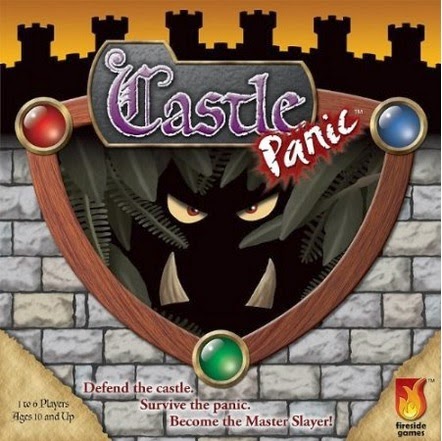
Game Review: Castle Panic

Remember the board games you played as a kid?  They were probably things like Life, Monopoly, and Yahtzee.  And while there's nothing wrong with these games, despite updates that make the games current (Doctor Who Yahtzee?!?!  I'm sold!), the new modern era of board games are a lot more fun and offer amazing opportunities for family bonding.

Doctor Who Yahtzee
Oops.  Is my inner geek showing?


I'm going to start by reviewing a game called Castle Panic. This was our family's first leap into a new genre of board games called "cooperative gaming".  Everyone works together: it's you vs. the game.  So you either all win together, or you all lose together. Cooperative gaming is a great way to play when you have younger school-age kids who want to join in the fun, but get tired of Mommy or Daddy or older sibling beating them all the time. 

Castle Panic
Orcs, and goblins, and trolls!  Oh my!

In Castle Panic, you have a castle set up in the middle of the board, with monsters on the outskirts, in the forest.  On your turn, you attack the monsters using your cards.  At the end of each person's turn, the monsters move closer to the castle, and two new monsters are placed on the board.  There are specialty cards and specialty monsters that add variety to the game. 


Some monsters only need one "hit", some need two or three to be taken off of the board.  When a castle wall gets run into by a monster, it is removed from the game.  If the monsters knock down all of your walls, you lose the game.  If you manage to kill all of the monsters before they knock down all of your walls, you win!!

When we play, we lay out our cards in front of us so we all know what we have in our hands, and it's easy to trade cards and make a plan of attack.  Because of this cooperative style of play, you can easily involve children of all ages.  Our 2 year old is still too young, but our 5 year old can easily hold her own with Mommy and Daddy there to guide her just a little.


One of my favorite aspects of Castle Panic is that there are additional rules you can throw in the game to change it up a little and make it more competitive.  As you kill monsters, you can count points.  The person with the most points is the "Master Slayer".  Or you can have one person be the "Monster Overlord": on their turn they decide where on the board the monsters go in order to knock down the castle.  Both rules add an extra element of fun to the game.

I would recommend this game for kids ages 5+, depending on the child of course.  The theming is fun (who doesn't love monsters!) and the mechanics are simple.  It's a great family board game. 

Speaking in Absolutes

Do you remember as kid, your mom would tell you, "Stop jumping on the bed.  You're going to break your leg".  Or, "Get down from that wall.  You're going to fall off and crack your head open."  How often did you actually break your leg, or crack your head open?  True; there was a kid here or there that did, but most of us were able to come out without a scrape.

What does that do to the parent/child relationship, when Mom (or Dad) says "If you do (this), then (that) will happen," and it doesn't?  Mom loses credibility because she's wrong.  Kid chooses not to listen to Mom anymore because she's always wrong.

Enter a better way:  Do your best to avoid speaking in absolutes, which is making wide, sweeping statements that appear to apply to everyone in every situation.  Like when Mom says "Don't cross your eyes or they'll get stuck that way."  No they won't.  But when you declare a consequence that never happens, you lose credibility with your children and they begin not to trust you.

Instead, try, "If you jump on the bed, you may fall down and hurt yourself."  Or, "The wall is very high.  I'm worried that if you fall, you can really get hurt."  Switch words like "you will" and "you are going to" for words like "you may" or "you could".

You are still sharing potential consequences, but aren't doing it in a way that will break trust should the negative consequence not happen.  And you are still doing your job as a parent to keep your kids safe by warning of negative consequences.

Validating Fear

I love lessons from watching other parents at Disneyland.  I try not to judge; every child is unique and presents their own challenges.  But occasionally I find a message I think can be applied universally.


One time we were in the line for Peter Pan.  There was a kid a few families in front of us that was kind of freaking out about the ride.  They were your basic 4 year old concerns: "It's too loud", "It's too dark", "I'm scared", etc.  Nothing unusual for a 4 year old..  But this poor kid's Dad wasn't having it.

First, he tried telling the boy that there's nothing to be scared of.  That didn't work.  When you're feeling anxious or scared, does a good "you're being paranoid" lecture ever work for you?  It doesn't work for me, and isn't likely to work for a child.

Next, he moved onto the "Look, that baby is younger than you and SHE'S not scared" tactic.  He pointed to my Dolly, who was about 7 months old at the time.  Well of course she's not scared.  She's a baby!  She doesn't know how to be scared yet!

That would be like my husband trying to quell my overly-irrational fear of spiders by saying "Well, Booboo isn't scared of spiders."  Well, of course not!  He's 2 years old!  He still thinks they're awesome and goes running after them to pick them up.  The comparison isn't going to do anything to change my fear.  If anything, it's going to make me feel stupid, and embarrassment is never a motivator to change for any age.

Validating Fear - How to help your child overcome fears without marginalizing themSo, how do you handle a child's fear?  To begin, make sure to acknowledge it.  "I know you're scared of this ride.  I understand that you're saying you are scared of the dark."  Your simple acknowledgment of the fear is a huge step to building the trust needed to overcome that fear.

You can easily throw in some empathy, too.  "You know, I was afraid of the dark (loud noises, heights, etc.) when I was a kid.  I overcame it by ________."  You will suddenly become qualified to help them through this journey of facing their fears.

Do your best to explain to your child that it's your job as a parent to keep them safe, and you would never put them in an unsafe situation.  Let them know that you'll hold their hand, they can sit on your lap, or whatever they need to do in order to feel safe when confronting their fear.  Ask them to come up with ideas.  They may very well know what they need.  It may be as little as a promise to hold their hand.

Some kids are logical, and once they see the logic of the situation, it becomes less scary.  Especially when the fear is of something unknown (like an unfamiliar dog, or a new ride at Disneyland), all it takes is a simple explanation.  "You're right, it is dark, but they only make it dark in that part of the ride so you can see the lights twinkle like the night sky.  And don't you remember how much we loved camping and looking at the stars?  It's just like that."  If you have a more logical child, don't be afraid to work that angle.

Going through these steps won't automatically cure your child of their fear.  It's not my place to tell you to whether to force your kids to confront their fear head-on.  You know your child best.  Whether you make them go on the ride (or pet the scary dog, or whatever) is up to you.  If you DO chose to make them confront those fears, they will do it knowing that you understand their fears, and they will feel secure that you are going to do your best to protect them.